The Problem
Our planet consumes
26,000 TWh per year.
Terrestrial solar energy loses ~30% to atmospheric absorption, and is limited by the day-night cycle and seasonality. P.O.L.A.R.I.S. proposes capturing energy directly from space — where the Sun shines 24/7, at an intensity 457× greater than at Earth's surface.
Discover the architecture →Solar intensity at 7M km
Power delivered continuously
Of global 2023 consumption
YBCO critical temperature
Key data
The numbers that matter
power delivered
≈ 48% of global electricity
of global electricity
for a Kardashev 1 civilization
per YBCO cable
superconductor at 77K — liquid nitrogen
Dyson mirrors
Ø 1 km · 7 million km from the Sun
collector satellites
43% laser efficiency · solar orbit
solar intensity
457× that of Earth's surface
System Architecture
Four modules.
One coherent energy chain.
30 mirrors · Ø 1 km · 7 million km from the Sun
Dyson Ring of Mirrors
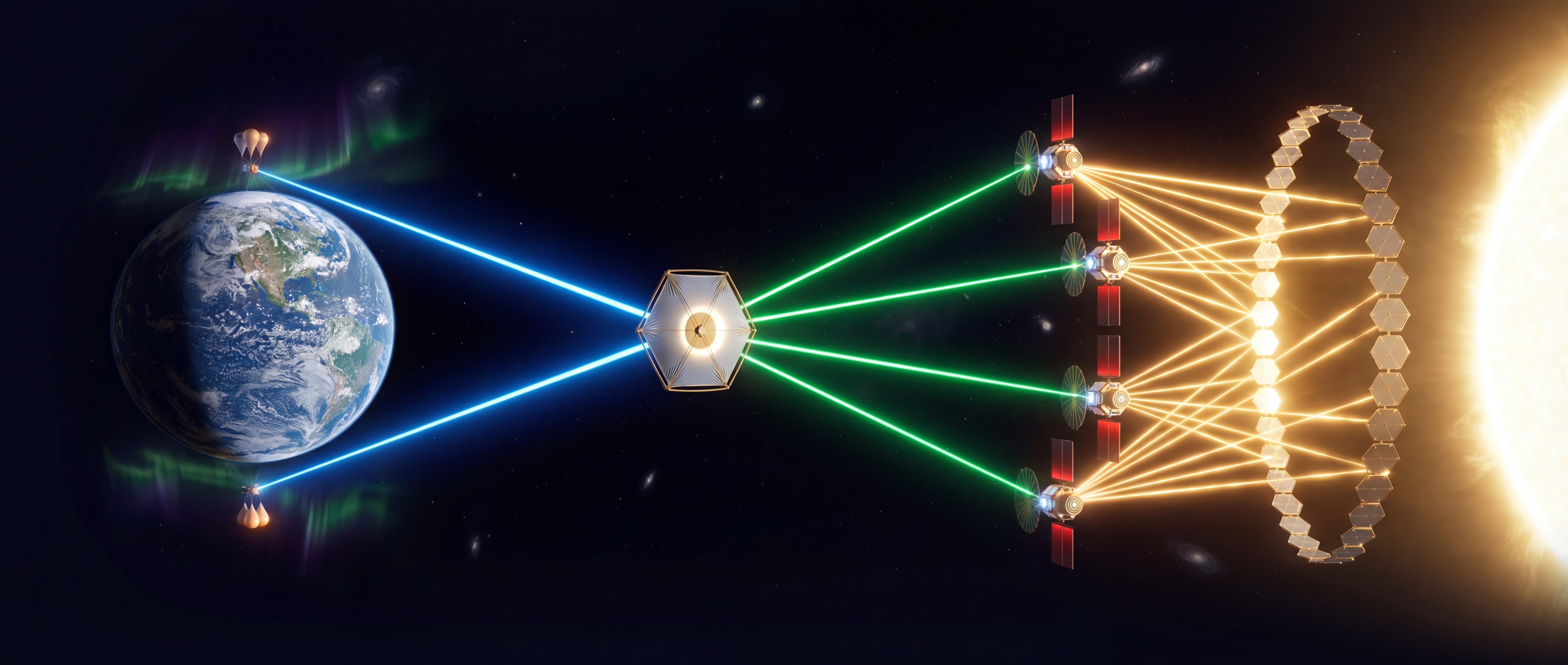
At 7 million km from the Sun, solar radiation intensity reaches 622,000 W/m² — 457× that at Earth's surface. 30 orbital mirrors, 1 km in diameter, concentrate this energy toward the collector satellites, with 90% reflectivity.
Technical details →4 satellites · η = 43% · Green + blue laser
Laser Collector Satellites
The 4 collector satellites convert concentrated solar energy into high-power laser beams (43% efficiency), equipped with ion propulsion systems to maintain orbit and directional laser transmitters aimed at the Lagrange nodes.
Technical details →Stable gravitational equilibrium · 2×800 GW transfer
Lagrange L4/L5 Nodes
The L4 and L5 Lagrange points are positions of stable gravitational equilibrium in the Sun–Earth system. The energy nodes placed here receive the laser energy and redistribute it to the YBCO polar stations on Earth.
Technical details →YBCO 77K · 800 GW per cable · Global HVDC distribution
Star Power Grid Network
YBCO superconductors (YBa₂Cu₃O₇₋δ) operate at 77K with liquid nitrogen — compared to 4K for classic NbTi used in the LHC magnets. An innovation validated through consultation with CERN physicists.
Technical details →The complete energy chain
Civilizational vision
The Transition
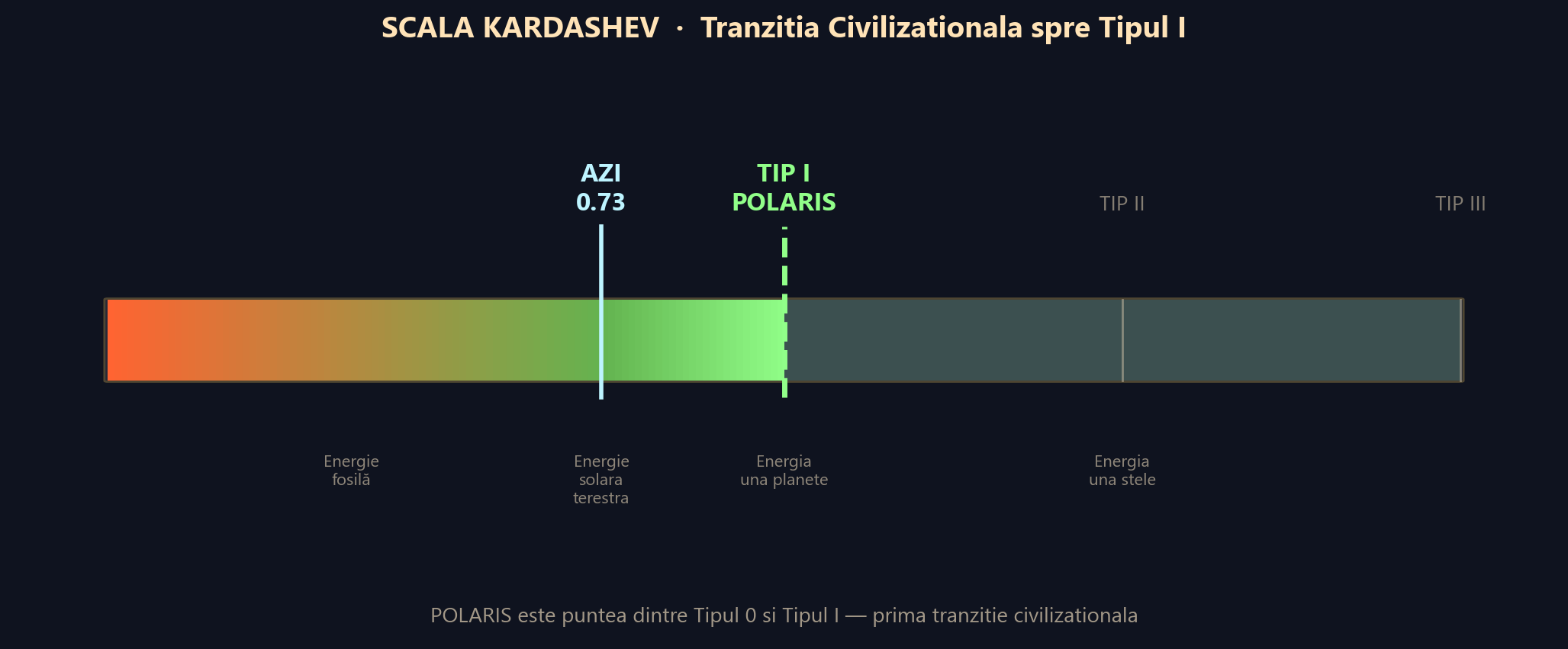
Kardashev 0.73 → 1.0
The first civilization to fully master its own planet's energy. P.O.L.A.R.I.S. is not a simple engineering calculation — it is a vision of humanity's destiny.
Now · Kardashev 0.73Earth today — fragmented energy, dependent on fossil fuels
P.O.L.A.R.I.S. · Kardashev 1.01.6 TW delivered continuously — the first Type 1 civilization

Team
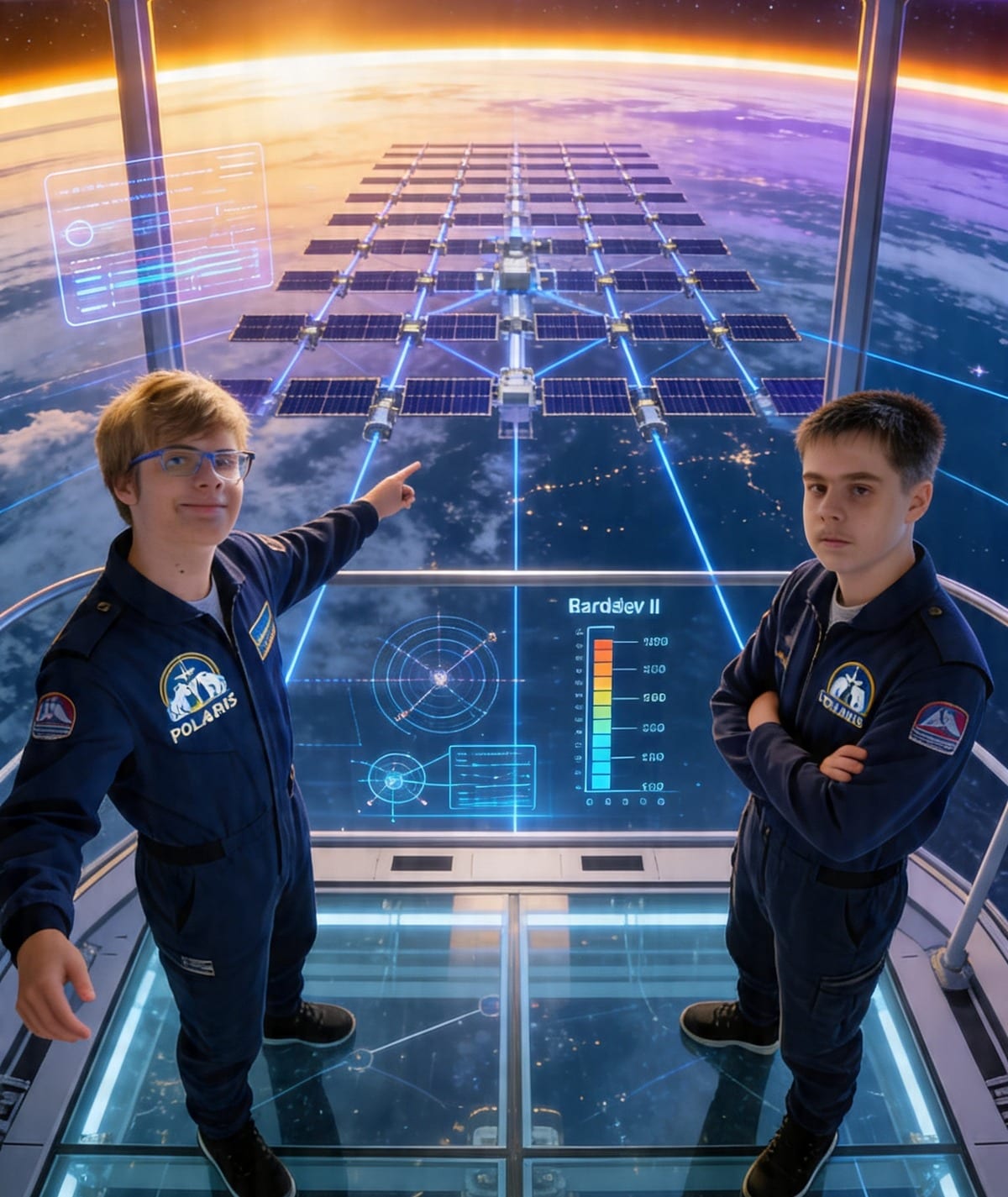
POLARIS Bears
Innovating the present. Powering the future.
★National Olympiad Medalists
Albert OLARIU
Researcher
Ioan CHELARU
Researcher
Collaborators
Prof. Univ. Dr. Valentin BARNA
Scientific collaborator
Faculty of Physics, University of Bucharest · Optics & Photonics
Consulting: principles of photonics and solar radiation → LASER conversion
Carlo Emilio MONTANARI
Collaborator — Applied physicist
PhD Candidate in Beam Dynamics, CERN / Univ. Bologna
Consulting: high-precision beam dynamics (LHC → POLARIS)